
Special Educational Needs
At Yate Academy, we provide students with an unrivalled quality of education. This is underpinned by an ethos of strong discipline, excellent manners, and exceptional teaching. We have the highest expectations for our students and believe there is no ceiling to what a child can achieve through hard work and dedication. Alongside a rich and carefully considered curriculum, students have the opportunity to engage in a broad enrichment programme. We give our students experiences that allow them to maximise their potential regardless of their starting points and believe that true inclusion is achieved by creating an environment that allows every child to learn.
Our graduated response
At Yate Academy, we have a graduated response to students’ needs. All teachers receive training on what this looks like for students in our school and their roles and responsibilities in this process. The diagram below shows this process:
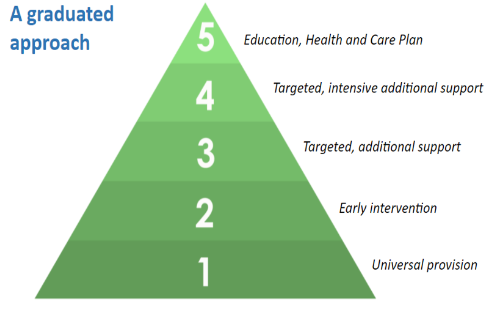
The information below shows what is in place at the flowing stages and where Pupil Passports may be introduced as a monitoring tool for teachers (and parents), when potential barriers/needs have been identified.
Link to above table.
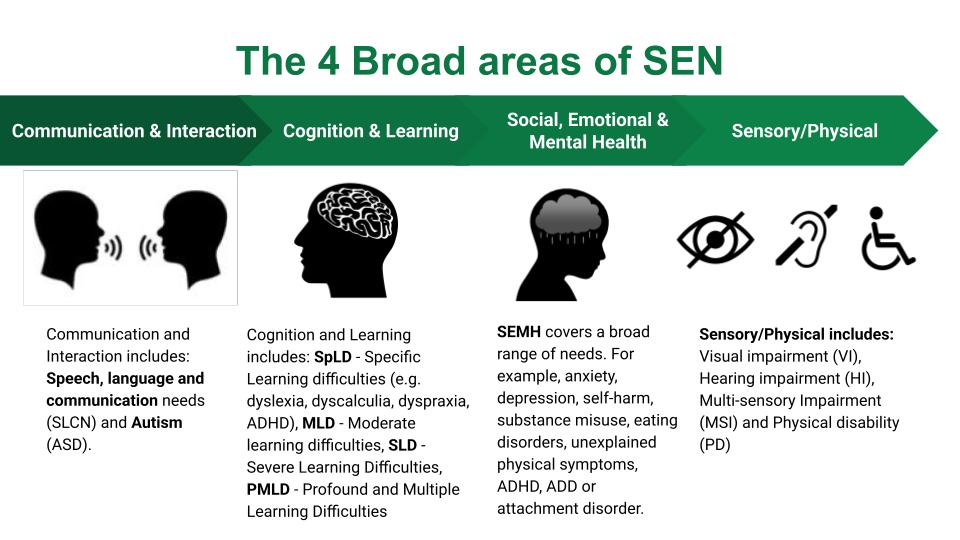
What does it mean to have a Special Educational Need?
A student has SEN if they have a learning difficulty or disability that requires special educational provision to be made for them.
They have a learning difficulty or disability if they have:
-
A significantly greater difficulty in learning than most others of the same age; or
-
A disability that prevents or hinders them from making use of facilities of a kind generally provided for others of the same age in mainstream schools.
Special educational provision is educational or training provision that is additional to, or different from, that made generally for other children or young people of the same age by mainstream schools.
Yate Academy is ambitious for its students and we believe that there is no ceiling on what can be achieved by anyone, regardless of their circumstances or background. We are committed to providing a supportive and inclusive learning environment, giving every young person the opportunity to fulfil their potential now, and in the future.
The leaders at Yate Academy are leaders for all students, enabling our teachers to be teachers of all students. Yate Academy is committed to distributed leadership to secure the best possible provision and outcomes for students with special educational needs. We have the same ambition for all our students, and recognise the importance and impact of prioritising our responsibilities to students with special educational needs.
We work in partnership with students and their families in identifying and providing for special educational needs. Where appropriate, we also work in partnership with other agencies. We recognise the importance of communication being inclusive, accessible and culturally sensitive to achieve effective partnership working.
What this means at Yate Academy
A typical day of support for a student with SEND may look like the following:
- Arrive at school and be warmly greeted at the door by a member of the senior team.
- Access the quiet area of learning support, to chat with SEND staff and peers before the start of the day and regulate.
- Attend roll call with their peers, receive any missing equipment, check in with their tutor and listen to key messages for the day, prewarning them of any changes.
- Walk calmly to tutor reading with their peers and start the day listening to an expert member of staff deliver one of the great stories of our time.
- Attend two morning lessons, being supported by teachers through the core routines providing chunked, precise instruction, in a disruption-free classroom designed with students with SEND at the forefront.
- Be rewarded by their classroom teacher with merits for excellent work and effort. Potentially receive the Golden Ticket at the end of their lesson for demonstrating the school’s values of Leadership, Resilience or Citizenship.
- Get a snack from the canteen and spend breaktime with friends either outside or up in the supported Learning Support area. Receive positive signatures on their character card for polite interactions with staff and supporting peers.
- Attend break time line up, celebrate the school’s values and reset and regulate for a calm start to period 3.
- Attend period 3 and 4, and continue to build on previous knowledge and skills from the curriculum. Teachers support them through utilising the individual provisions from their student passports. At times, they may receive additional support from a teaching assistant.
- Attend a lunchtime club or whole school house challenge.
- Attend the final lesson of the day and then celebrate the day's successes with peers at the end of day lineup. Followed by leaving the site calmly with their peers and teacher, potentially attending an after school sports club or homework support.
Our SEND team
|
Katie Barber |
I am dedicated to fostering an environment where every student is empowered to reach their highest potential and develop into a successful, independent lifelong learner. |
|
Tim Pottle
|
Every child deserves the right to a fulfilling, supportive and rewarding education no matter their individual needs. I strongly believe that with the right support our students with SEND can accomplish the most widely aspirational goals. |
|
Ros Hannam |
My vision is to create a fully inclusive environment where specialist support bridges the gap between potential and achievement for every deaf student. We are dedicated to nurturing confident, independent communicators who are proud of their identity and equipped with the self-advocacy skills to navigate the world. |
|
Mr B Slinn |
I am dedicated to the belief that every student, regardless of background or ability, can excel when provided with the proper scaffolding. My goal is to empower learners to overcome obstacles and realize their full potential. |
|
Mrs D Hendy
|
I am dedicated to ensuring our deaf and hard-of-hearing students feel safe, understood, and fully included in every aspect of school life. My daily mission is to build their self-belief so they can walk into any room and know they belong. |
|
Mrs N Ely
|
I believe that literacy is the passport to the wider world, and I am passionate about ensuring every student has the skills to navigate it. Through targeted interventions and patient guidance, I work to close the gap between struggling readers and their peers. |
|
Mrs S J Parker |
My professional focus is on equity in education; I strive to remove barriers to learning so that every student is equipped to pursue their academic and personal ambitions. |
|
Mrs K Sims |
With the right support, all students can achieve regardless of the barriers to learning they may face. I am committed to ensuring all students can achieve their dreams and ambitions. |
|
Mrs L Scaife |
I serve as the central link between families, agencies, and the school to ensure every student’s needs are accurately communicated and documented. My goal is to support students to thrive and ensure they have a better chance of success here than anywhere else. |


content
Identification and assessment of children with SEND
Parents/carers are informed when students are added to or removed from the SEN register. When deciding whether special educational provision is required, we will start with the desired outcomes, including the expected progress and attainment, and the views and aspirations of the pupil and their parents/carers. We will use this to determine the support that is needed and whether this can be provided by adapting our core offer, or whether something additional is needed.
We work in close partnership with families and local settings. Many students with special educational needs will therefore be identified through the transition and induction process.
On entry, we assess each student's current skills and levels of attainment, which will build on previous settings and Key Stages, where appropriate. We carry out additional diagnostic tests for any student scoring below a standardised score of 90 in their reading assessment.
Class teachers make regular assessments of progress for all students and identify those whose progress:
- Is significantly slower than that of their peers starting from the same baseline
- Fails to match or better the child’s previous rate of progress
- Fails to close the attainment gap between the child and their peers
- Widens the attainment gap
- Demonstrates high levels of dysregulation
In addition, the behaviour, safeguarding, attendance and SEN team meet each week to discuss the needs of our students. This includes progress in areas other than attainment, for example, social needs. Attendance and behaviour data might also be used to identify which pupils require additional support.
Slow progress and low attainment will not automatically mean a pupil is recorded as having SEN.
Where a parent/carer has a concern about their child, parents are asked to speak with the student's head of year or the SENDCO so that appropriate observations and assessments can be undertaken.
Transition from Year 6
The SENCO has excellent relationships with staff at our feeder primary schools.
During Term 4 or 5, the SENCO/ KS3 Raising Standards Leader and the Head of Year 7 start to meet with the teachers, SENCOs and Head Teachers of the primary schools to gather information about students who will be part of the new Year 7 cohort.
The SENDCO also goes to see the students in lessons to see how they interact, make progress and behave. Information from these Year 6 transition visits with the primary schools is combined into a Pupil Passport for students for their new teachers at YA. This is created in Term 6 with both the parent and the student.
If a child has an Education, Health and Care Plan, the SENCO should be invited by the primary school to attend the Year 6 Annual Review Meeting.
For some students who may require an enhanced transition package, we run an enhanced transition programme during the final term of Year 6. This programme consists of:
-
A visit to the school when it is quiet to take photos.
-
A visit at break and lunch time to see the queues, hear the bells and to see line up. It is an opportunity to ask questions and to look at some of the schools’ resources.
-
A visit after our two day transition programme for all students to complete a treasure hunt.This is for students with an EHCP and vulnerable students at SEN support as highlighted by their primary school.
A small minority of students will require further enhanced transition and this could include visits to Yate Academy from as early as January in Year 6.
Parents and children are welcome to visit to support the transition process
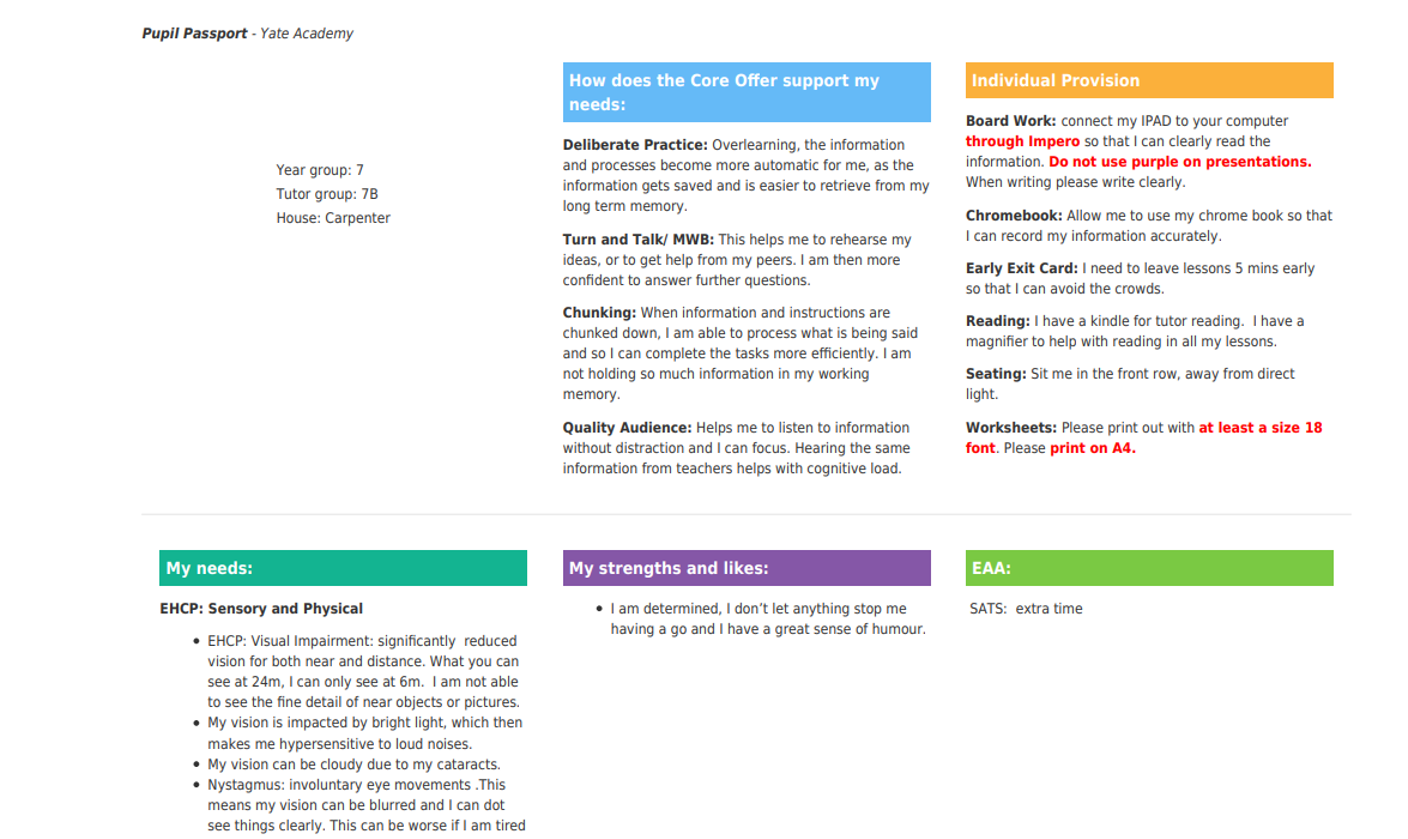
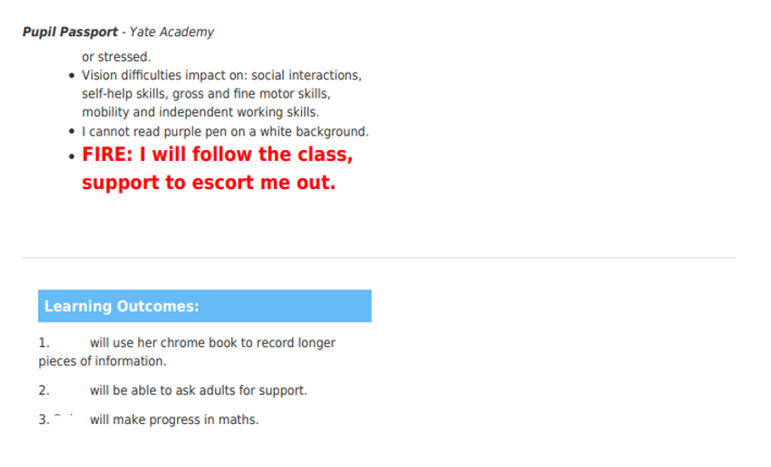
Pupil Passport
A pupil passport is a regularly reviewed document that contains the needs, strengths and individual strategies for every student with an EHCP or on SEN Support. These are developed in partnership with pupils and their parents/carers. Where appropriate, they might also include strategies recommended by other professionals.
Learning plan
Some students who require more specialised support will have individualised learning outcomes on their student passports. All interventions to support progress towards these outcomes are recorded on individual student APDR documents.
These will:
- Track progress against long-term outcomes in Educational, Health and Care Plans (EHCNAs) for students working below age related expectations.
- Inform medium-term and daily curriculum planning and provision where children are accessing adapted curriculum pathways.
- Inform intervention planning.
Link to an example plan here.
Universal provision – high quality teaching
Yate Academy ensures that a universal provision of high quality teaching is able to address gaps in foundational knowledge and skills. Through evidence-informed classroom routines and a well-planned curriculum, teachers are able to address reading fluency and accuracy, communication and language skills, writing composition and number facts. Our carefully selected and sequenced curricula ensure foundational subject specific knowledge is secure at every step. For some students, effective targeted support in the classroom ensures gaps are identified and tackled quickly through our responsive and adaptive classroom practice
Targeted support
Where appropriate, teachers are made aware of the focus of any intervention so that they can support pupils to generalise the skills learnt back to the classroom.
Interventions are reviewed every half-term to check the impact against the intended outcome. Where the intervention is not having impact as expected, changes will be made to the intervention.
Students with an EHCP have three targets on their student passport linked to the outcomes on their EHCP which is shared with all teaching staff.
|
Intervention |
Access criteria |
|
Read Write Inc – Fresh Start |
NGRT SAS score below 90. |
|
Social skills |
Students identified at Team around the Child meetings, and through EHCP recommendations that would benefit from support with peer relationships and social communication. |
|
Speech and language: language for behaviour and emotions |
Students identified at Team around the Child meetings, and through EHCP recommendations that would benefit from support with understanding and expressing their emotions. |
|
Touch typing |
Students who have the provision of a Chromebook who have been identified with slow typing speed. |
|
Handwriting support |
Students who have been identified by staff and through their EHCP provision. |
|
Reading fluency |
Students who have completed RWI and need further support with their reading speed. |
|
Entry level English |
Students in KS4 who have received reading intervention at KS3 and who have significantly low reading scores. |
|
English pre and post teaching |
Students in KS4 who have significantly low reading scores and through recommendation in their EHCP. |
|
Timeout card |
Students identified at Team Around Child meetings, through EHCP provision and or professional reports. |
|
Early exit card |
Students identified at Team Around Child meetings, through EHCP provision and or professional reports. |
|
Resilience Lab |
Students identified at Team around the Child meetings, and through EHCP recommendations, that would benefit from support in managing their anxiety and self-confidence. |
|
Daily reflection/end of day check out |
Students identified through ECHP recommendations or a report from a professional practitioner. |
|
Y7 Anxiety Group |
Students identified at Team around the Child meetings: attendance, self esteem, difficulties managing their anxieties. |
|
1:1 meet and greet |
Students identified through ECHP recommendations or a report from a professional practitioner. |
|
Unstructured time support |
Students identified through ECHP recommendations or advice from other professionals. |
|
Learning Support Homework Club |
Students identified at Team Around Child meetings, through EHCP provision and or professional reports. |
Specialist support
At Yate Academy, we work in partnership with a range of external agencies and they will support the planning and delivery of specialist interventions. This might include mentoring, support with speech and language therapy sessions or access to specialist mental health support.
This includes:
- 1:1 teacher of the deaf lessons
- Deaf wellbeing support
- Visual Impairment support – VI Team
- Educational psychologist support
Where appropriate, teachers are made aware of the focus of any intervention so that they can support students to generalise the skills learnt back to the classroom.
Interventions are reviewed at least every term to check the impact against the intended outcome. Where the intervention is not having impact as expected, changes will be made to the interventio
Staff training
Our SENCO is an experienced teacher who obtained her National SENDCO Award in 2012. Our SENCO has further post graduate qualifications in supporting vulnerable learners and dyslexia and learning difficulties.
Each week, the SENCO delivers bite size training to support various groups of students and once a term, either the SENCO or the teacher of the deaf will lead a better practice briefing on a particular area of SEND to ensure that the needs of our students are understood and met in the classroom through our high quality inclusive teaching.
Inclusive teaching and learning is at the heart of all we do at Yate Academy and, as such, we have a teaching and learning coaching team which consists of the SLT team, lead practitioners and the SENCO. This group facilitates the academy’s coaching programme to ensure that all staff have regular access to high quality and individualised professional development. Each member of the coaching team is assigned to an individual teacher or group of teachers.
Our team of teaching assistants are able to attend the teaching and learning CPD programme both in house and with Greenshaw Learning Trust. In addition, our TAs each have a subject specialism and attend fortnightly intellectual preparation sessions, which are led by our heads of department. This ensures that our team has a solid understanding of the curriculum and therefore can support our learners with greater expertise.
Staff within the Learning Support Department have also received training on:
- HRB TAs: deaf awareness training/anxiety in deaf children
- Supporting well being and behaviour through emotional coaching
- Read Write Inc
- Languages for behaviour and emotions
- First aid
- ASD
- How to support students with their exam access arrangements
- Child protection training and Prevent training
- Maximising the impact of TAs in the classroom
- Safeguarding training
- Using Eduley and APDR to inform and review student provision.
- Manual handling
- SEND and specialist provision maximising impact in the classroom
- Attachment and trauma
- Speech and language: links between speech and language needs and SEMH
- Supporting sensory needs
- Writing pupil passports.
The local authority also commissions training on speech and language intervention and provides termly training sessions based on individual students who have an identified speech and language need.
Useful links
Teacher handbook: SEND
With contributions from specialists across the sector, the handbook is a comprehensive resource for teachers and parents to use over time. It brings together practical examples of high-quality teaching - placing focus on removing barriers to learning, getting to know and understand individual learners, and bringing to life the graduated approach. To access this free resource click on the link below and sign up to Whole School SEND:
Whole school SEND online CPD units
Free, flexible online learning to help develop inclusive practice.
Link to the SEN Information Report
Policies are saved on the school website here. SEN information is currently being reviewed by governors for approval.